
Subtotal $0.00
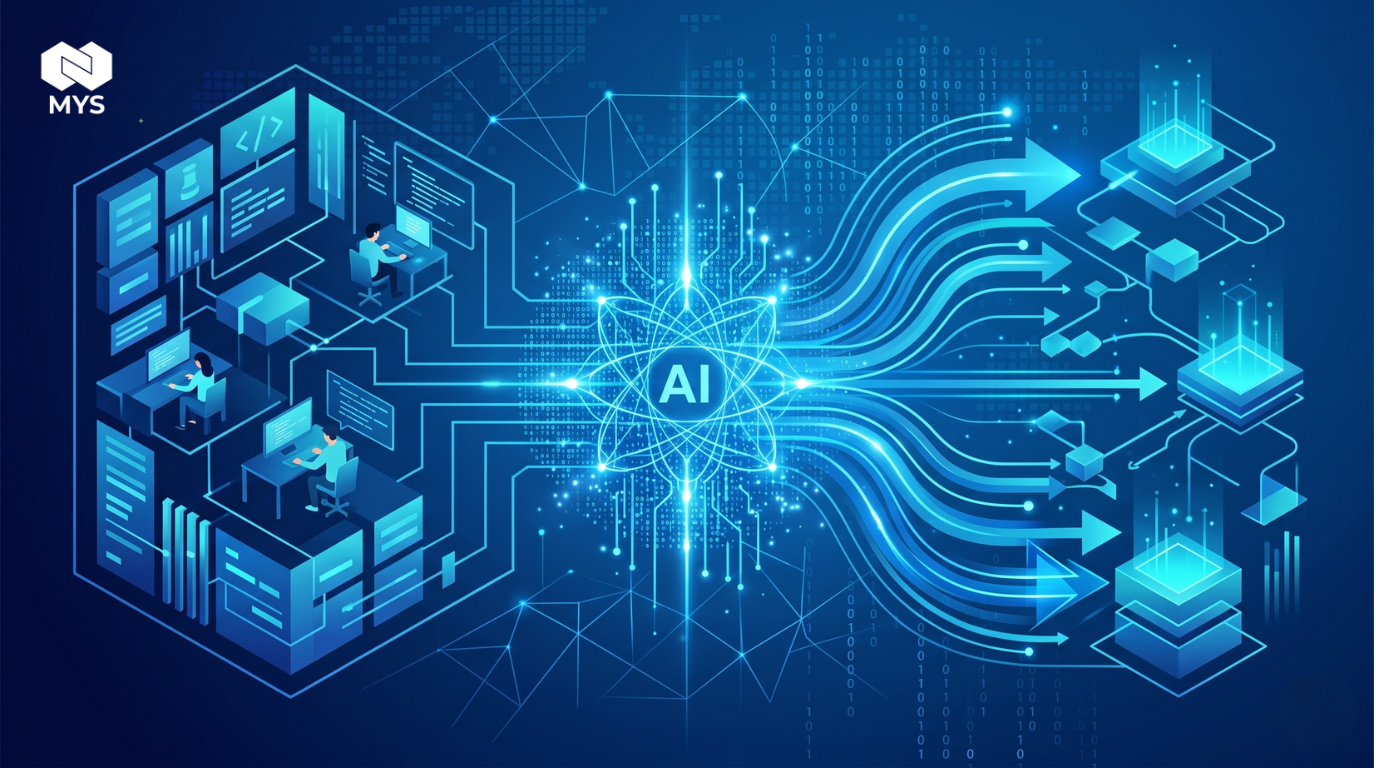
The widespread adoption of AI coding tools has prompted many technology leaders to reconsider their outsourcing strategies. Some have argued that tools like GitHub Copilot, Cursor, and Claude Code reduce the need for external development teams. A closer look at current market data and industry behavior tells a more complicated story.
AI Adoption Among Development Teams Has Reached Scale
AI coding tool usage has grown substantially across the industry. According to a 2026 survey by Pragmatic Engineer, 73% of engineering teams now use AI coding tools on a daily basis, compared to just 18% two years prior. GitHub Copilot reached 4.7 million paid subscribers in January 2026, with approximately 90% of Fortune 100 companies deploying the tool across at least part of their engineering workforce.
The productivity impact is measurable. A controlled study conducted by GitHub and Harvard University found that developers using AI pair programming tools completed tasks 55.8% faster than those working without them. McKinsey reports that developers using AI tools are nearly twice as likely to report sustained focus and higher job satisfaction.
These figures confirm that AI tools are meaningfully changing how software gets written. What they do not confirm is that outsourcing demand is declining as a result.
Outsourcing Demand Continues to Grow
The global IT outsourcing market is projected to reach $639 billion in 2026, according to Mordor Intelligence, with growth of more than 17% expected over the following five years. The underlying drivers remain intact: talent shortages in developed markets, rising domestic engineering salaries, and increasing demand for specialized skills in AI, cloud infrastructure, and cybersecurity.
Deloitte’s most recent Global Outsourcing Survey adds important context. In 2020, 70% of companies cited cost reduction as their primary reason for outsourcing. That figure has fallen to 34% in the latest survey. The leading motivations are now access to specialized talent and the ability to meet rising technical demands that internal teams cannot address at speed.
This shift reflects a maturing market. Outsourcing is no longer primarily a cost arbitrage exercise. For a growing share of businesses, it is a deliberate capability decision.
What Changes When Developers Work Faster
When AI tools allow a developer to produce output 55% faster, the implications for outsourcing relationships are significant in both directions.
On one hand, clients receive more output per engagement. Delivery cycles compress. Features that previously took weeks can be completed in days. For businesses with well-defined requirements and strong engineering oversight, this is straightforwardly positive.
On the other hand, faster delivery creates new pressure points that are easy to underestimate. Specification quality becomes more critical. Vague requirements fed into AI tools produce plausible-looking code that may pass initial review while introducing logic errors, security gaps, or architectural debt downstream. Research from 2026 found that while GitHub Copilot suggests code completions at a 46% rate, only around 30% of that output is accepted by developers after review. The remainder is caught during the review process or, in weaker workflows, is not caught at all.
The practical consequence is that the difference in output quality between a vendor with disciplined AI integration and one without has widened considerably. Speed without process rigor is now a more significant risk than it was before these tools existed.
The Skills Required of Both Sides Have Shifted
Effective use of AI coding tools requires more than tool access. It requires developers who understand when to accept AI suggestions, when to override them, and how to recognize failure modes specific to generated code, including insecure patterns, hallucinated function calls, and overconfident output in unfamiliar domains.
Vendors who have built structured review practices around AI-generated code are delivering a qualitatively different product than those who have not. When evaluating outsourcing partners in 2026, the relevant questions are not simply whether a team uses AI tools, but how they validate the output, how they handle cases where AI suggestions are incorrect, and whether they can demonstrate improvement in delivery metrics over the past year.
The client side carries equal responsibility. Faster delivery cycles require faster feedback. If a vendor is now shipping pull requests in half the time, but review and approval cycles on the client side remain unchanged, the efficiency gain is lost and the relationship becomes misaligned. The best outsourcing engagements in 2026 are structured around tighter collaboration rhythms, clearer upfront specifications, and shared accountability for code quality throughout the process.
Two Markets Are Forming Within Software Outsourcing
The outsourcing market is increasingly separating into two distinct segments.
The first is commodity outsourcing: vendor relationships defined primarily by hourly rate, with interchangeable teams and limited technical depth. AI tools are compressing margins in this segment further, as the productivity gains from AI make low-cost labor even lower-cost, while doing little to address quality and communication risks.
The second is strategic outsourcing: partnerships defined by technical capability, integration with the client’s engineering culture, and the ability to deliver complex work reliably. This is the segment where AI tools are creating genuine leverage, because disciplined teams are now able to handle larger scopes with the same headcount while maintaining or improving quality standards.
For businesses making outsourcing decisions, this distinction matters more than it did in previous years. The gap between the two segments is widening.
Considerations for Selecting an Outsourcing Partner in 2026
Given the shifts described above, several factors deserve particular attention when evaluating software outsourcing vendors this year.
Code review practices for AI-assisted output. A vendor should be able to describe specifically how they review code that is generated or suggested by AI tools. Generic statements about code quality are insufficient. The review process for AI output requires different checkpoints than review of code written entirely by hand.
Measurable productivity changes. Vendors who have integrated AI tools effectively should be able to quantify the impact on their delivery timelines or test coverage. If a vendor cannot describe what has changed in their workflow over the past 12 to 18 months, that is a relevant signal.
Security and compliance practices. AI-generated code is associated with higher rates of insecure patterns. Research indicates that approximately 40% of programs generated with AI assistance have been flagged for security issues in independent testing. Vendors working in regulated industries or handling sensitive data should have explicit policies addressing this.
Communication and specification process. Given that faster delivery cycles place greater demands on the client’s ability to provide clear direction, a vendor’s approach to requirements definition is as important as their technical capabilities. Structured onboarding, documented specifications, and proactive clarification processes all reduce the risk of misalignment.
Conclusion
AI coding tools are not reducing demand for software outsourcing. They are changing what effective outsourcing looks like and raising the consequences of choosing the wrong partner. Businesses that evaluate vendors on price alone, or that treat outsourcing as a set-and-forget arrangement, face greater exposure in 2026 than in previous years.
The companies that will benefit most from the current moment are those that approach outsourcing as an active partnership, select vendors who have demonstrably integrated AI tools into sound engineering practices, and maintain the internal capacity to provide clear direction and timely review.
The fundamentals of good outsourcing have not changed. The cost of ignoring them has.
MYS Vietnam provides full-stack software development services from Hanoi, with expertise in front-end, back-end, mobile, and AI development. We work with businesses across industries to deliver reliable, well-engineered software at scale.